PENP Calculator UK: How Post-Employment Notice Pay Is Worked Out
Learn how a PENP calculator works in the UK, what HMRC's formula means, and why notice pay inside a settlement is often taxable.
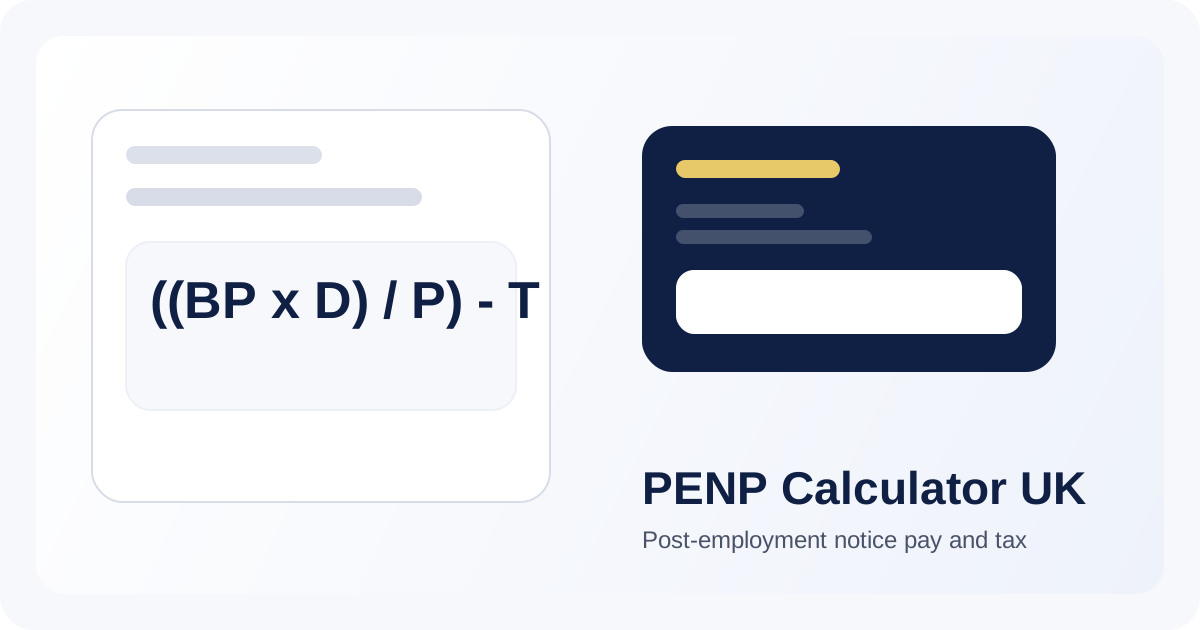
Need the numbers now?
Use the Settlement Tax Estimator
Get an instant estimate in your browser before you read the deeper guidance below.
If you are looking for a PENP calculator UK, you are usually trying to answer one question: how much of a termination package counts as taxable notice pay rather than part of the potentially tax-favoured termination amount.
PENP stands for post-employment notice pay. HMRC treats it as earnings, which means it does not benefit from the usual GBP30,000 termination-payment threshold. That is why PENP often becomes the most argued-over number in a settlement agreement.
What PENP is in simple terms
PENP is meant to capture the value of notice pay an employee should have received if they had worked, or been properly paid for, their notice. HMRC’s guidance explains that it applies where the employee receives no notice, or less notice than they were contractually or statutorily entitled to receive.
The official HMRC manual describes the formula at EIM13880.
HMRC’s PENP formula
HMRC’s published formula is:
((BP x D) / P) - T
Where:
| Input | Meaning |
|---|---|
| BP | Basic pay in the last pay period before the trigger date |
| D | Calendar days in the post-employment notice period |
| P | Calendar days in the last pay period |
| T | Certain taxable termination payments already counted |
If the result is negative, PENP is treated as nil. If the result is larger than the relevant termination award, it is capped at that award.
Why PENP matters so much in settlement agreements
Employees often hear that “the first GBP30,000 can be tax free” and assume the whole notice element fits inside that rule. HMRC says otherwise. The notice-pay portion identified as PENP is taxed as earnings first. Only the balance of the relevant termination award is considered separately.
That is why a settlement can look tax-efficient at first glance but still produce a larger tax deduction than expected once the PENP element is carved out.
Use the Settlement Tax Estimator to sense-check the numbers before you rely on a headline offer.
What usually counts as basic pay for PENP
HMRC’s guidance at EIM13882 says “basic pay” excludes things such as overtime, bonus, commission, gratuity, and allowances. That means employees can be surprised when PENP is lower than full normal earnings in one case, or when a settlement adviser uses a more stripped-back pay figure than expected.
The key point is that PENP is formula-driven. It is not just a free-form negotiation label.
Worked example
Suppose:
- monthly basic pay is GBP3,100
- the last pay period is 31 days
- unworked notice is 30 days
- no taxable PILON has already been separately counted
The formula would be:
((3,100 x 30) / 31) - 0 = 3,000
So roughly GBP3,000 would be identified as PENP and taxed as earnings.
Common mistakes with a PENP calculator
The most common errors are:
- using total package value instead of basic pay
- forgetting that the calculation uses calendar days
- treating the whole settlement as tax free up to GBP30,000
- missing taxable PILON already counted in “T”
These mistakes often push a tax estimate too high or too low.
What to check before signing
If you are reviewing a settlement agreement, ask for:
- the notice period used
- the basic pay figure used
- the number of days in the pay period
- the number of days treated as post-employment notice
- a separate figure for PENP and for the remainder of the termination payment
That breakdown is often the difference between a transparent offer and a confusing one.
Frequently Asked Questions
Is PENP always taxable in the UK?
PENP is generally taxed as earnings. HMRC’s guidance is clear that it does not benefit from the GBP30,000 threshold that may apply to other parts of a termination payment.
Does a PENP calculator UK use gross pay or basic pay?
It uses a basic-pay concept defined by HMRC, not a broad “everything on the payslip” approach. Overtime, bonuses, and similar items may be excluded.
Is PENP the same as PILON?
Not exactly. PILON is a payment in lieu of notice. PENP is the tax calculation used to identify notice pay that should be taxed as earnings, whether or not the payment is described that way in the agreement.
Can a settlement agreement still have a tax-free element after PENP?
Yes. PENP is stripped out and taxed first. The remaining termination award may then be considered separately, including the usual termination-payment rules.
The Bottom Line
A PENP calculator UK is really a way of applying HMRC’s notice-pay formula to a termination package. The critical questions are the notice period, the basic pay figure, and whether any taxable PILON has already been counted. Use the Settlement Tax Estimator to sense-check the split before agreeing to a final settlement figure.
Step-by-step checklist
Identify the notice period that was not worked
PENP focuses on the notice you were entitled to but did not work before employment ended.
Find the inputs for the HMRC formula
You need the employee's basic pay, the number of days in the post-employment notice period, the number of days in the last pay period, and any taxable notice payment already counted.
Compare PENP with the rest of the termination award
PENP is taxed as earnings, while the remaining termination award may be treated differently.